


TL;DR: The root « jur » means law, right, or justice, deriving from Latin « jus. » Understanding what the root « jur » means helps decode words like jury, justice, jurisdiction, and perjury. Words containing « jur » typically relate to legal matters, oaths, or fairness, making this root essential for building legal and formal English vocabulary.
If you’ve ever wondered what does the root jur mean, you’re exploring one of the most influential building blocks in the English language. The root « jur » (sometimes appearing as « jus » or « just ») comes from Latin and carries the core meaning of law, right, or oath. Understanding this root can unlock the meaning of dozens of words you use every day, from « jury » to « justice. » In this comprehensive guide, we’ll break down the origins, meanings, and practical applications of this powerful linguistic element. ⚖️
Frequently Asked Questions

What does the root ‘jur’ mean?
The root ‘jur’ comes from Latin and means ‘law,’ ‘right,’ or ‘to swear.’ It appears in many English words related to legal systems and oaths. For example, ‘jury’ refers to a group sworn to give a verdict, and ‘justice’ relates to fairness under law. Understanding this root helps you decode legal and formal vocabulary quickly.
What are common words that use the root ‘jur’?
Common words using the root ‘jur’ include jury, jurisdiction, jurisprudence, perjury, conjure, injury, and abjure. Each connects to the idea of law, rights, or swearing an oath. For instance, ‘perjury’ means lying under oath, while ‘jurisdiction’ means the authority to apply law. Recognizing ‘jur’ makes these words easier to understand and remember.
Where does the root ‘jur’ come from?
The root ‘jur’ originates from the Latin word ‘jus’ or ‘juris,’ meaning ‘law’ or ‘right,’ and ‘jurare,’ meaning ‘to swear.’ It entered English through Old French and Latin legal terminology. This is why so many English words tied to law, courts, and oaths contain ‘jur,’ reflecting its historical roots in the Roman legal system.
What is the difference between the roots ‘jur’ and ‘jus’?
The roots ‘jur’ and ‘jus’ are closely related and both derive from Latin, meaning ‘law’ or ‘right.’ ‘Jus’ is the nominative form (as in ‘justice’), while ‘jur’ comes from the genitive stem ‘juris’ (as in ‘jurisdiction’). They are essentially variations of the same root, used interchangeably depending on how a word is formed in English.
What does the word ‘perjury’ mean using the root ‘jur’?
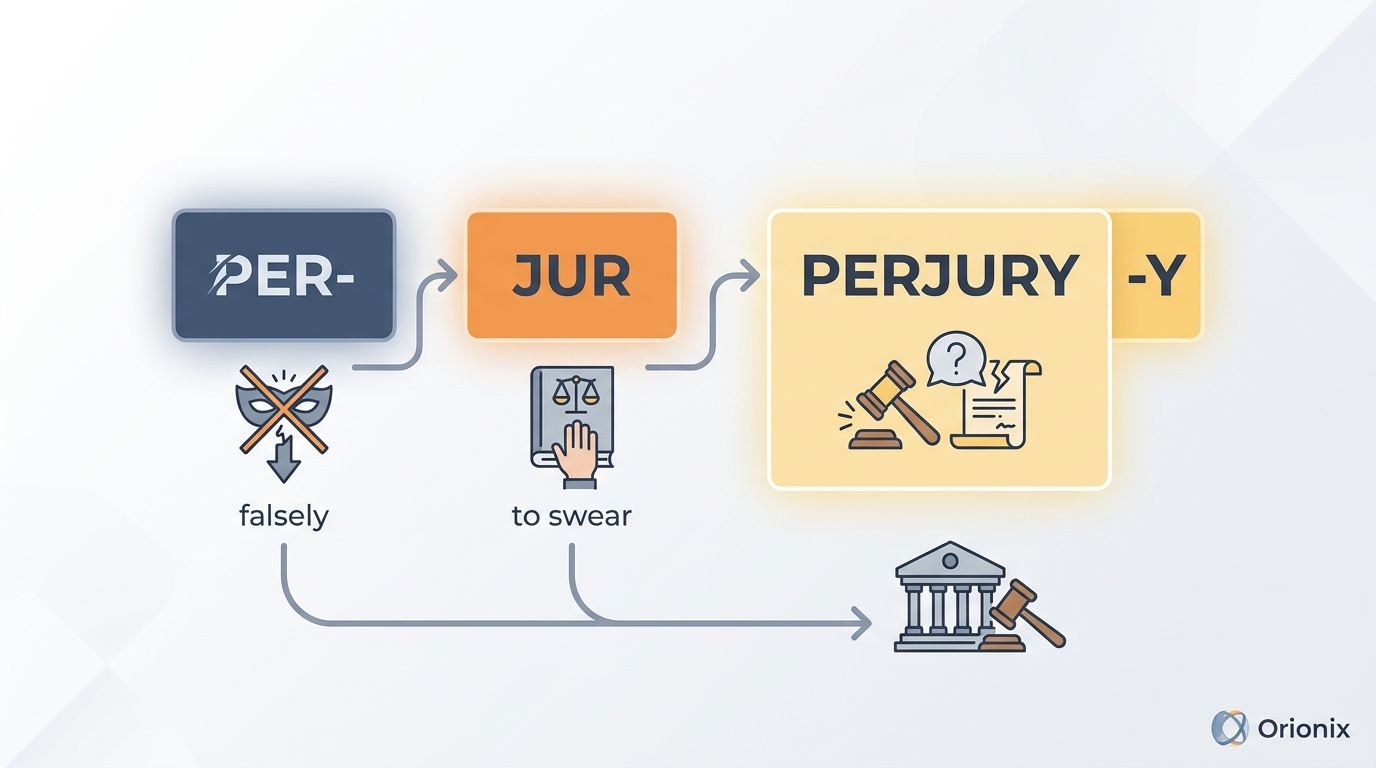
‘Perjury’ combines the prefix ‘per-‘ (meaning ‘falsely’ or ‘through’) with the root ‘jur’ (meaning ‘to swear’). Together, it means to swear falsely or lie while under oath in a legal setting. Committing perjury is a criminal offense because it undermines the integrity of the justice system by providing false sworn testimony.
How does knowing the root ‘jur’ help improve vocabulary?
Knowing the root ‘jur’ helps you decode unfamiliar words related to law and oaths without a dictionary. Once you recognize that ‘jur’ means ‘law’ or ‘to swear,’ you can infer meanings of words like ‘jurisprudence’ or ‘abjure.’ This strategy boosts reading comprehension, test performance, and overall vocabulary retention by connecting related words through their shared origin.
Is the root ‘jur’ a prefix or a suffix?
The root ‘jur’ is neither a prefix nor a suffix—it is a base root that carries the core meaning of a word. Prefixes like ‘per-‘ or ‘con-‘ attach before it, and suffixes like ‘-y’ or ‘-diction’ attach after it. As a root, ‘jur’ provides the fundamental meaning of ‘law’ or ‘to swear’ around which words are built.
What does ‘conjure’ mean and how does it relate to ‘jur’?
‘Conjure’ combines the prefix ‘con-‘ (meaning ‘together’) with the root ‘jur’ (meaning ‘to swear’). Originally it meant to swear together or make a solemn oath. Over time, its meaning shifted to summoning spirits or magically producing something, as in conjuring an image. It still reflects the root’s connection to invoking or calling forth through words.
What Does the Root Jur Mean? A Clear Definition
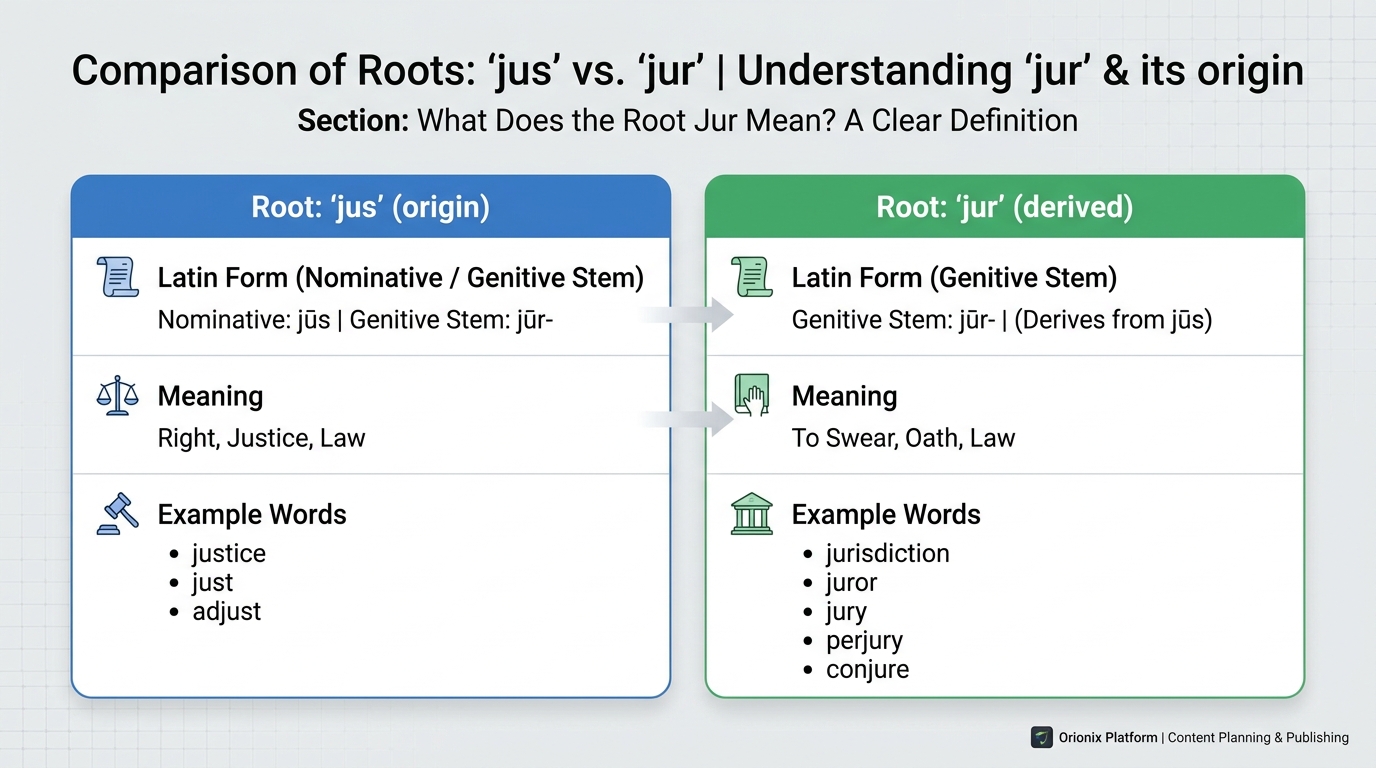
The Latin root « jur » derives from the word jus (genitive juris), which translates to « law » or « right. » When you see this root in a word, it almost always relates to legal concepts, justice, or the act of swearing an oath.
Because English borrowed heavily from Latin—especially in legal and governmental vocabulary—the « jur » root appears in a wide range of terms. Recognizing it helps you decode unfamiliar words and expand your vocabulary quickly.
The Core Meanings of Jur
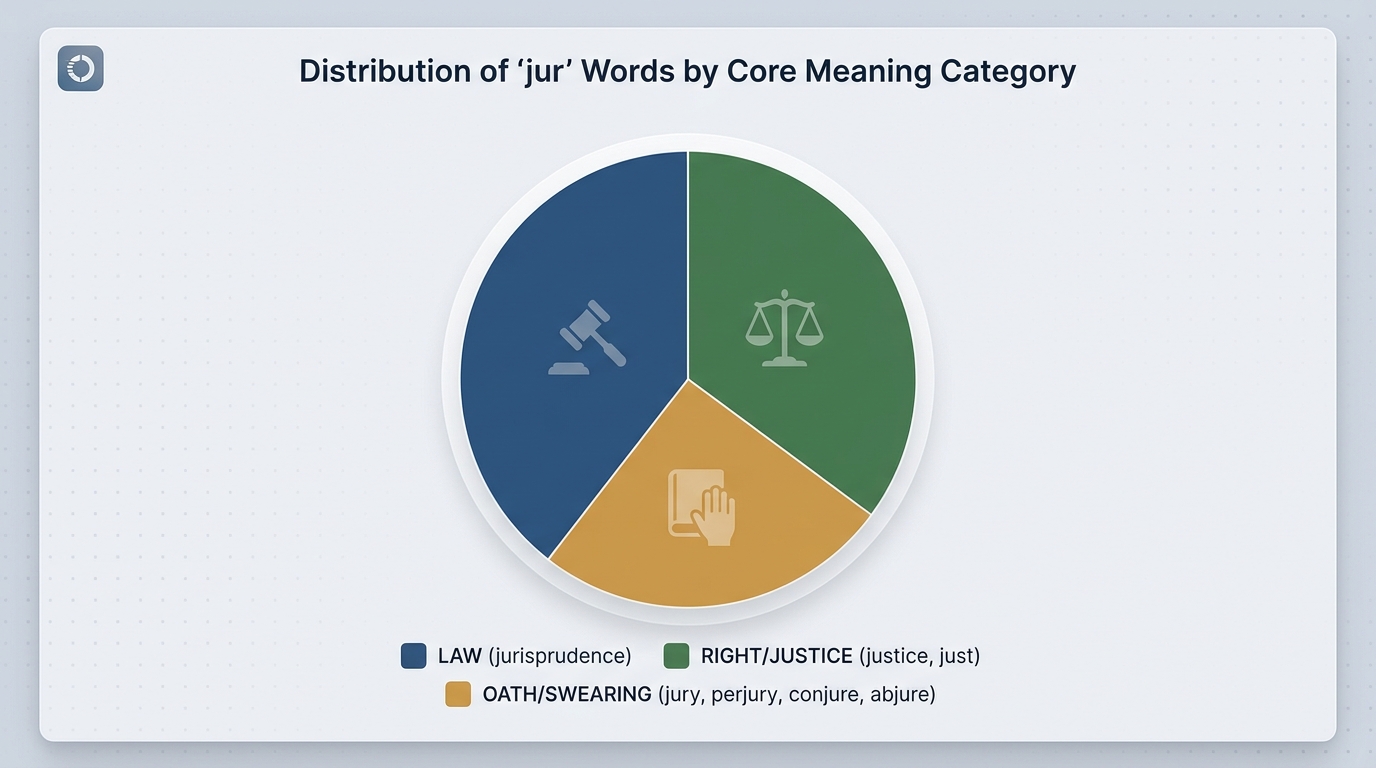
- Law — as in « jurisprudence » (the study of law)
- Right or justice — as in « justice » and « just »
- Oath or swearing — as in « perjury » (lying under oath)
These three interconnected ideas—law, rights, and oaths—form the foundation of every word derived from « jur. » 📚
Common Words Built From the Root Jur
Once you understand the root, dozens of words become instantly more transparent. Below is a table of frequently used « jur » words along with their definitions.
| Word | Meaning | Connection to « Jur » |
|---|---|---|
| Jury | Group of people sworn to give a verdict | They take an oath (jur) to judge fairly |
| Justice | Fair treatment according to law | Rooted in « right » and « law » |
| Jurisdiction | Official authority to make legal decisions | « Jur » (law) + « diction » (to speak) |
| Jurisprudence | The theory and philosophy of law | « Jur » (law) + « prudence » (knowledge) |
| Perjury | Lying while under oath | « Per » (through/false) + « jur » (oath) |
| Abjure | To solemnly renounce a belief | « Ab » (away) + « jur » (swear) |
| Conjure | To summon or call upon (originally by oath) | « Con » (together) + « jur » (swear) |
How Prefixes and Suffixes Change Jur Words
Prefixes and suffixes dramatically alter the meaning of « jur » words. Just as understanding a root helps you decode vocabulary, understanding affixes is equally valuable. For example, if you’ve wondered what does the suffix on mean, learning affixes alongside roots gives you a complete picture of word construction.
- Ab- (away) + jur = abjure (to swear away)
- Per- (falsely) + jur = perjury (false oath)
- Con- (together) + jur = conjure (to call forth)
The Historical Origins of Jur
The root traces back to ancient Roman law, where jus represented the entire system of legal rights and duties. Roman legal principles heavily influenced Western law, which is why so many English legal terms share this Latin foundation.
When you sow the seeds of understanding one root, you reap a broader vocabulary—much like the reap what you sow definition reminds us that effort in learning yields lasting rewards. Studying etymology is one of the most efficient ways to grow your word power. 🌱
Jur in Modern Legal Language
Today, « jur » words remain central to courtrooms, contracts, and government documents. Terms like « jurist, » « juridical, » and « jurisdiction » are essential in legal writing and everyday news reporting.
- Jurist — an expert in law
- Juridical — relating to judicial proceedings
- Injury — literally « against the law » (in- + jur), meaning harm or wrong
Why Learning Word Roots Matters
Mastering roots like « jur » offers practical benefits beyond passing a vocabulary test. It improves reading comprehension, boosts communication skills, and helps you understand shorthand in everyday conversation.
In fact, the same decoding skills you use for Latin roots apply to modern slang. Ever wondered what does and mean in text messages, or how abbreviations evolve? The ability to break down and interpret language works across formal and informal contexts alike.
Practical Tips for Remembering Jur
- Associate « jur » with a « jury » swearing an oath in court.
- Group related words together (justice, jurisdiction, jurisprudence).
- Practice using the words in sentences to reinforce meaning.
- Connect the root to real-world scenarios like trials or contracts.
Applying Vocabulary Knowledge to Content Creation
For content creators, marketers, and social media managers, a strong command of language is essential. Precise word choice makes your captions, blog posts, and campaigns more compelling and credible.
Whether you’re managing multiple accounts or coordinating cross-platform campaigns, clear communication drives engagement. Understanding vocabulary helps you craft messaging that resonates across every channel in your social media and content strategy.
Language Skills for Social Media Success
Effective social media marketing relies on choosing the right words for the right audience. Small vocabulary improvements can sharpen your brand voice and improve click-through rates.
- Write clearer, more persuasive captions for the best sites for instagram engagement.
- Optimize post copy to match the ideal dimensions for instagram post layouts.
- Learn platform mechanics like how to repost on instagram and how to erase posts on facebook to keep your feeds polished.
Modern social media management platforms make it easy to plan and schedule this content efficiently—so your well-crafted words reach the right people at the right time.
| Skill | Content Benefit |
|---|---|
| Root word knowledge | Faster, clearer writing |
| Precise vocabulary | Stronger brand voice |
| Understanding tone | Better audience connection |
| Editing efficiency | Consistent, professional posts |
Conclusion: Turn Word Power Into Content Power
Now you know exactly what the root « jur » means: law, right, and oath. This single root unlocks dozens of English words and demonstrates how understanding etymology sharpens your overall command of language. 🎯
Clear, confident writing is the foundation of great content—and great content deserves great tools. If you’re a content creator, marketer, or business owner managing posts across multiple channels, streamline your workflow with a single, powerful dashboard. Plan, create, and publish everything in one place with Orionix. Visit our website to see how you can simplify your social media strategy today.
Article created using IntentRank